'Last piece' in place for Des Moines pro soccer as city approves funds
December 8, 2025
This article was originally published in the Des Moines Register. Click here to read the full article.
What one backer called "the last piece" of a long-unsolved puzzle has fallen into place as Des Moines City Council approved a $7 million tax increment financing deal for a pro soccer stadium on a remediated Superfund site adjacent to downtown Des Moines.
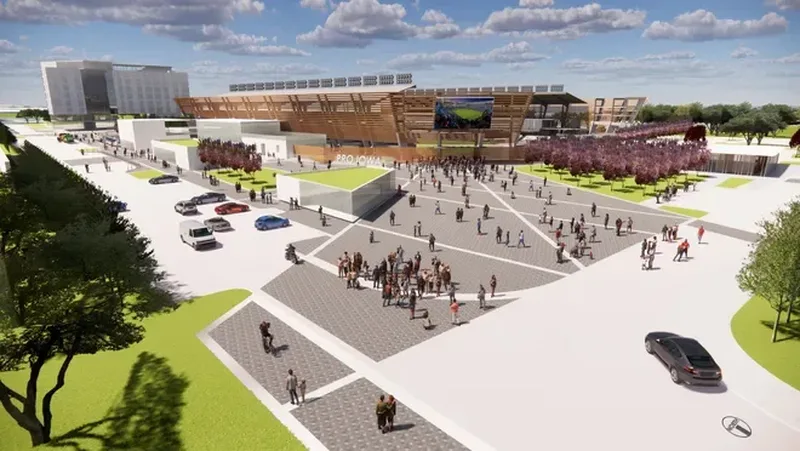
The agreement to help finance the Pro Iowa stadium and a companion events plaza across Martin Luther King Jr. Parkway from downtown's Western Gateway won unanimous approval during the council's Monday, Dec. 8, meeting.
With the additional funding, private donations and what it called "value engineering," officials from the Iowa Soccer Development Foundation, which will own the stadium, said the group had closed a funding gap that has held up construction for years.

The group hopes to break ground for the stadium and plaza in late 2026 or in 2027, said Jeff Lorenzen, president of the nonprofit foundation's board.
"It's the last piece of the puzzle in terms of our capital stack to move this project forward," Lorenzen said.
He added that the pro men's and women's teams for which former Kum & Go owner Kyle J. Krause's Krause Group holds promised franchises could hit the field in late 2028 or 2029.
"This is an important step for an important project," said City Council member Josh Mandelbaum, whose Ward 3 includes the site.
The land once housed a factory that left significant chemical contamination. The Dico factory's remains have been cleared, along with the contaminated soil, and a monitoring system is in place.
"There has been a lot of work to keep this project moving, and this is a step in that direction," said Mandelbaum.
The Iowa Economic Development Authority chose the project in 2021 in a statewide competition for Iowa Reinvestment Act funding, and construction had been slated to start in 2024. The Krause Group's development arm, Krause+, pitched the stadium as the linchpin for a wider redevelopment of the former factory site and enhancement of the Western Gateway, where the Krause Group has its headquarters on Grand Avenue and significant additional land holdings.
The IEDA gave the stadium project additional funds earlier this year, and Polk County also pitched in. Krause and his wife, Sharon, led private donations to the project, but a $22 million budget shortfall remained as construction prices rose, pushing the cost of the stadium to $95 million from a 2019 estimate of $60 million.
The city pledged $1.5 million for the plaza, which officials hope to use for festivals now held in Western Gateway Park. But it was not until Monday that the council approved the additional funds for the stadium that the foundation, whose seven-member board includes Krause, had long pushed for.
Lorenzen said changes to the stadium plan have cut its cost, and the additional private donations, including from Krause, have brought the total available for the project to $90.8 million ― sufficient to cover the cost.
"We will continue to do fundraising" to revive some of the features cut, including some of the planned parking, Lorenzen said. "But we wanted to get that core foundation of dollars in the capital stack committed so we can start the project, and we can always expand on it in the future."
Under requirements attached to the city's tax increment financing, the stadium and plaza must be completed by Dec. 31, 2029.
Addressing Superfund site always was a costly goal, says council member
Mandelbaum said that even without the stadium, it would have required a financial commitment from the city to make the site suitable for reuse.
"We would have work and a significant investment regardless of whether the stadium is there," he said. "The fact that we have the stadium, which is a tremendous community asset coming, is fantastic for the city and a great value for the city and will be something that benefits this community for decades to come."
Lacking the city's tax increment financing, Lorenzen said, the project would have seen more delays as it tried to cut costs while complying with United Soccer League requirements.
"I don't know that we can value engineer additional pieces out of it and still comply with the USL constraints for the franchise," he said. "We would have to look and see what other options we would have available to potentially fill that last gap."
What is the city requiring in exchange for the tax incentive?
Aside from meeting the Dec. 31, 2029, deadline, the foundation must comply with a list of stipulations from the city before receiving the tax increment financing. Among them:
- The stadium and events plaza must be available for other users.
- The stadium, planned to accommodate 8,000 fans, must have at least 5,500 seats in its final form.
- Krause's company must, as planned, land the second-tier USL Championship League men's and top-tier women's Gainbridge Super League teams from the United Soccer League.
- Design of the stadium and plaza will be subject to review by the city's Urban Design Review Board, with the City Council having final say on design plans and certification of the project's completion.
Krause+ has drawn up plans for $500 million in redevelopment stemming from the stadium project, and Mandelbaum said making progress on that plan is an important element in his support for the financing. The TIF deal requires the Krause Group to redevelop the land it owns in the Western Gateway to generate revenue for the bonds sold within the reinvestment district formed as part of the state funding package.
"So they very much have an incentive to get that done as part of this arrangement," Mandelbaum said. "Because if that development doesn't come, that's part of how they're getting paid back for their upfront investment."
For its part, the city agreed to alter the timeline for the tax increment financing. The city will provide the funding once the stadium is completed, as opposed to over a 20-year period, as initially proposed.
The TIF program aims to promote development by freezing property values for tax purposes, allowing additional taxes generated by increased property values resulting from development to be returned to a project.
Of the $7 million the city is committing to the project, $2 million will come from the sale of a city parking garage at Locust and Ninth streets downtown. Under the agreement, those funds must be used to build public parking in the stadium district.
The $1.5 million the city pledged to support construction of the plaza is not included in $7 million TIF agreement.
Market District locks in application for state funding
City Council on Monday also approved expanding the Reinvestment District boundaries east from the stadium site to include the Market District. The roughly 40-acre former industrial area south of the East Village has been readied for redevelopment with streets, utilities, landscaping and other amenities.
The intention of expanding the stadium redevelopment district to include the Market District, which is roughly bordered by Martin Luther King Parkway, East Vine Street and Southeast Sixth Street, is to put the project in the running for state funding. In September, the Iowa Economic Development Authority announced an additional $10 million up for grabs through the agency's reinvestment district program after canceling funding for a project in Ames.
Before reaching the TIF agreement, backers of the soccer stadium lobbied the city of Des Moines to split the potential funds between their project and the Market District. Now, if the Iowa Economic Development Authority awards the reinvestment district funds to the Market District, city officials have said they will go toward a "parking solution" to accommodate increased traffic from the expected development.
Support from the state would help builders finish the first phase of the area's construction faster, said Tim Rypma, president of Rypma Properties and one of the developers working on the Market District.
"Parking will be a catalyst to bring multi-family, retail, hospitality, etc.," Rypma said after Monday's vote, adding that the "Market District is very appreciative of the city of Des Moines council's support. It's a team effort, working with the city, to put this application together and advance it to the IEDA."
To view the original article on the Des Moines Register, click here.